
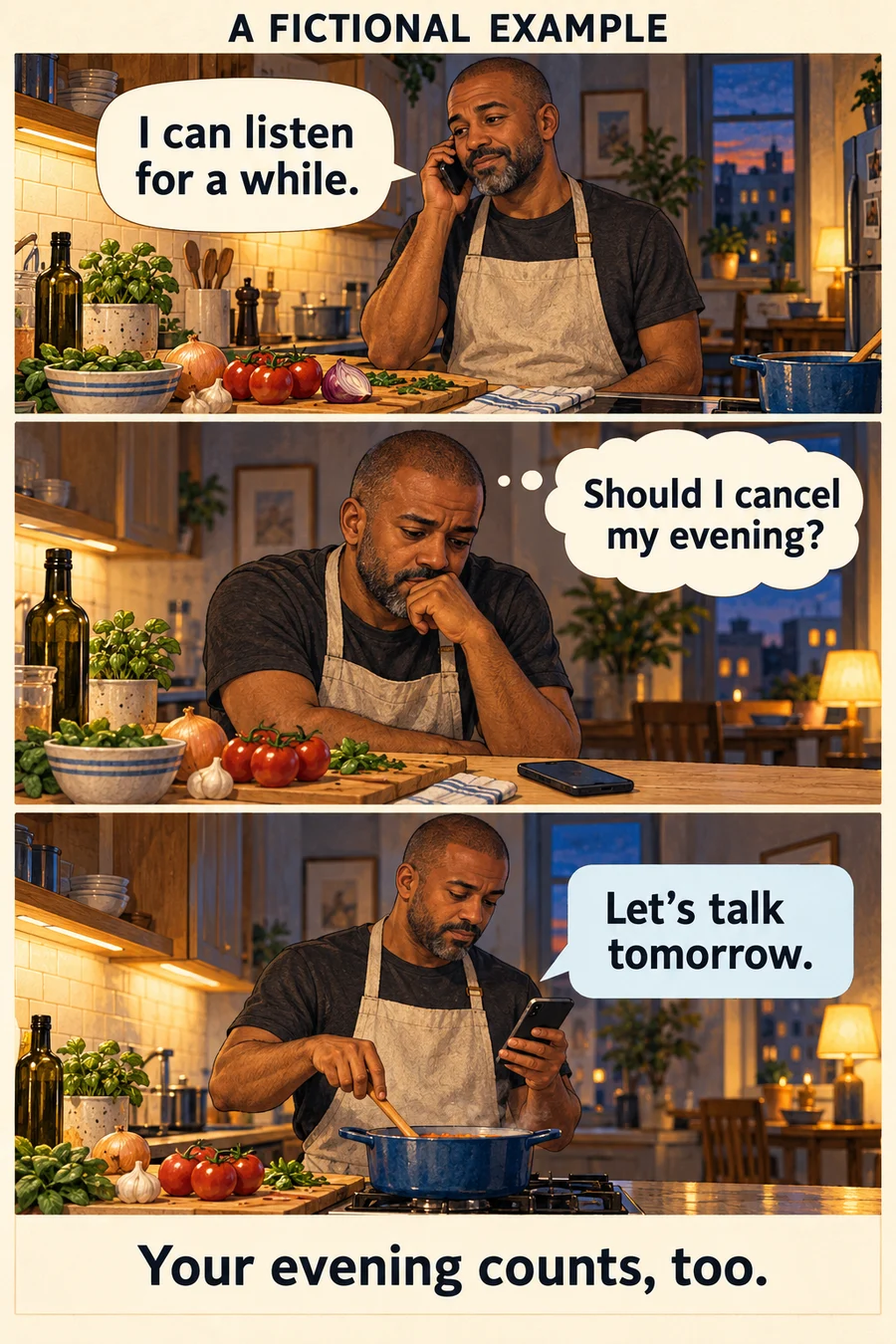
You can care about a friend’s bad evening and still have plans for your own.
Imagine they call after a frustrating day. You listen, ask a few questions, and offer to check in tomorrow. Then you spend the rest of the night wondering whether you did enough. You reopen the chat. You consider canceling your plans in case they want to talk again, even though they haven’t asked.
For someone who relates to familiar Cancer symbolism, this situation may feel recognizable. In conventional astrology, Cancer symbolism often centers on care, protection, and a need for emotional security. These are symbolic themes, not an obligation attached to your birthday.
The question of Cancer emotional boundaries begins with something practical: what support have you actually offered, and what responsibility have you silently added?
Notice the agreement inside the care
Listening for half an hour is an offer. Helping someone think through a problem is an offer. Being available until another person feels better is a much larger commitment, especially when neither of you has said that is the arrangement.
Ordinary responsibilities still matter. If you promised to collect someone, follow through or tell them promptly that the plan needs to change. But an unanswered question about their mood doesn’t automatically add new duties to that promise.
It can help to ask what kind of company they want. “Would you like me to listen, or would it help to think through what to do?” gives the other person a choice. You may discover that they wanted ten minutes to complain and then planned to make dinner.
You also get to say what you can offer. “I have some time now, and then I need to get back to my evening” is clear. Warmth can come from how you listen during that time, without making the conversation open-ended.
The Parents Palace includes the care you receive
A full Western birth chart includes planets, houses, and aspects beyond your Sun sign. Zi Wei Dou Shu uses a different arrangement: symbolic stars in twelve palaces, interpreted together.
The Parents Palace, or Fumu Gong, is useful to understand before reading it through a Cancer-like story about being everyone’s caretaker. In Sean Chan’s Parents Palace reference, its subject includes relationships with parents and, in modern practitioner interpretation, teachers, mentors, and other authorities. This is a domain of received support, guidance, and expectations as well as family relationships.
That broader meaning changes the direction of the question. Alongside asking whom you look after, you can examine whose approval you seek and who has been allowed to look after you. A family member’s unhappiness, a mentor’s disappointment, and a friend’s frustration can feel quite different even when each person makes the same small request.
The palace name doesn’t create a duty. A symbolic account of your relationship with authority cannot determine how much time you owe a parent, teacher, or employer. Present circumstances and actual commitments still need to be considered.
Read the symbol in its relationship setting
The palace heading is shared across charts; the stars within it give the interpretation its particular vocabulary. Chan gives Tian Liang in Parents as an example associated in the tradition with influential elders or mentors. In that placement, the symbol is read through a relationship with guidance and authority. It isn’t an instruction that the chart-holder must become the permanent adviser to everyone else.
A full reading also considers accompanying stars and the opposing palace, rather than treating a single symbol as a complete account. For this article’s question, a useful explanation would say how a theme of support or authority contributes to the overall interpretation. It should leave room for the difference between accepting guidance, wanting approval, and feeling responsible for someone else’s comfort.
Consider a hypothetical mentor who helped you early in your career and now regularly asks for favors. You may feel grateful. You may also have less time than you once did. If a reading gives you language for the importance of that relationship, you can use it to describe your gratitude more accurately. The favor still needs its own answer.
Compare that situation with a friendship in which you can easily say you’re tired. The contrast may tell you more than a broad claim that you’re naturally nurturing. It lets you see where you offer help freely and where you assume that declining would threaten a relationship you value.
YUVA’s Zi Wei Dou Shu introduction describes stars as parts of a combined interpretation. Read with the particular relationship in view: who is asking, what history matters, and what was actually promised.
Check what you know before offering more
When you feel pulled to do more, pause over four ordinary questions:
- What has the person said they need?
- What have I agreed to do?
- Am I responding to something they told me, or guessing from their tone?
- What can I offer without making a promise I won’t keep?
You don’t need perfectly tidy answers. Sometimes you won’t know what someone wants until you ask. Sometimes you will want to help beyond your usual limits because the occasion genuinely matters. That can be a considered choice.
The aim is to make your part clear enough that both people can respond honestly. A person who wants more time can ask for it. You can say yes, suggest another time, or explain that you can’t offer it today.
Suppose the friend from the opening calls again. You might say, “I’d like to hear how it went. I can talk tomorrow after work.” They may still be disappointed. You can acknowledge that feeling without promising a different evening solely to make the disappointment disappear.
Include your own evening in the picture
As you explore your chart, note whether you give your own preferences the same level of detail you give other people’s. “They need support” can be quite specific. “I’ll be fine” tells you very little about what you’re setting aside.
Perhaps you wanted to cook, see another friend, or simply have an uninterrupted hour. Write that down before deciding what to change. You may still choose to spend the time helping, but the choice will include a fuller account of your day.
For a starting point, open the free My Star preview on YUVA. Bring one recent situation to the reading and compare the interpretation with what each person actually asked for. If you decide to change an arrangement, make the change explicit so the other person has a chance to understand it.