
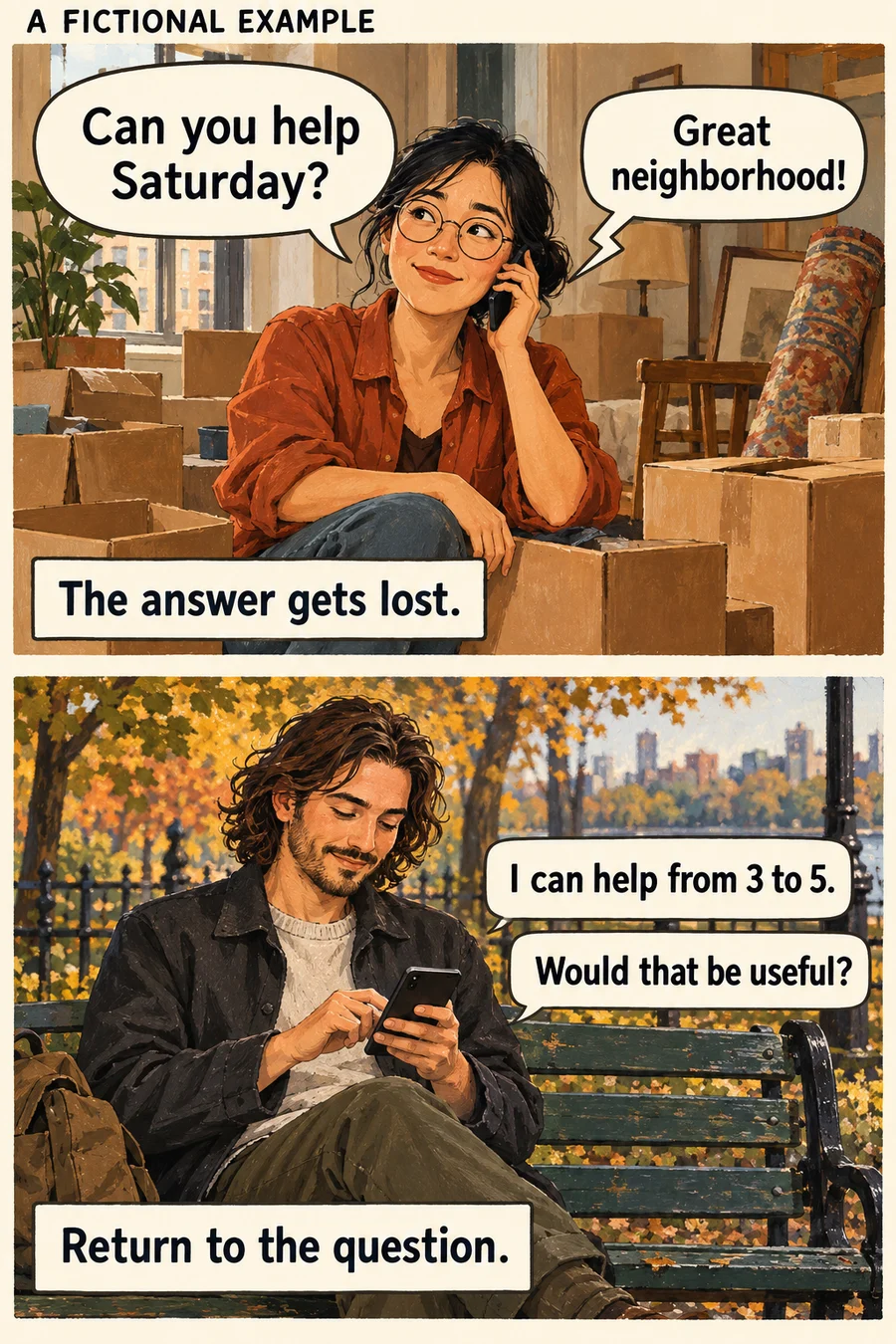
Suppose a friend asks whether you can help them move on Saturday. You talk about their new neighborhood, exchange restaurant recommendations, and laugh about the furniture that won’t fit through the door. Twenty minutes later, you hang up. Your friend still doesn’t know whether you’re coming.
Popular Gemini communication descriptions emphasize curiosity, verbal agility, and the pleasure of exchanging ideas. Astrodienst’s account of Gemini symbolism gives language and varied interests a prominent place. If you identify with that description, it’s worth looking at what happens after the interesting part of a conversation. Can the other person tell what you agreed to?
This question applies to anyone. Gemini is the familiar starting point here, not a diagnosis of how people born under one sign communicate.
Different conversations need different endings
Some conversations are meant to wander. A long lunch with a friend doesn’t need a decision or a summary. Interrupting it to establish action items would be a strange way to spend lunch.
Other exchanges have a practical purpose. Someone needs your answer before they can book a table, arrange transport, or finish their part of a project. More ideas may be welcome, but they don’t settle that dependency.
A difficult personal conversation has another kind of ending. You may understand each other better without agreeing. You may need a pause. What matters is that both people know whether the subject is settled, still open, or being left for another time.
When you lose track, ask, “What do we still need to work out?” The answer may be a simple yes or no. It may also reveal that you’ve been solving a different problem from the one the other person brought.
Look at the agreements behind the conversation
Western natal astrology considers planets, houses, and aspects alongside the Sun sign. Zi Wei Dou Shu offers another symbolic framework, arranging stars in twelve palaces and reading them in context.
Zi Wei Dou Shu places committed partnerships in the Spouse Palace, opposite Career. In Sean Chan’s Spouse Palace reference, readers examine these palaces together, connecting private partnership with professional life.
That pairing makes a generic assessment of “communication skill” feel incomplete. At work, you may be speaking within an explicit agreement: a deadline, a deliverable, or a decision someone is authorized to make. In a partnership, you may assume that the other person knows what your enthusiasm means. “That sounds lovely” could be taken as a commitment to a weekend plan even while you’re still considering it.
This everyday example is an application of the palace distinction. The chart framework doesn’t establish that work caused a relationship problem. It gives a reader reason to examine the terms of engagement in both settings instead of assuming your conversational habits operate identically everywhere.
How the stars enter that comparison
A palace names the area of life being read; its stars and their context supply the symbolic description. A useful reading should explain how the interpretation of partnership develops when considered alongside professional life. You should be able to follow that explanation beyond a list of personality adjectives.
You can use that approach to ask more of an interpretation. If it calls you adaptable, does it explain where adaptability helps you negotiate an agreement? Does it distinguish thinking aloud from promising something? A label about being talkative won’t answer those questions by itself.
You might be clear at work, where responsibilities are explicit, and vague with people close to you because you don’t want to disappoint them. Or the reverse may be true. The point is to retain those differences while reading, rather than make every conversation evidence for the same personality claim.
A Sun sign doesn’t tell you which Zi Wei star belongs in your chart. YUVA’s guide to Zi Wei Dou Shu explains the broader framework. Bring a real exchange to it, including what each person thought had been agreed.
Return to the question you left open
Go back to the moving-day example. Suppose you’d like to help but don’t know when your own appointment will finish. Several things could be true at once: you care about your friend, the conversation distracted you, and you can’t promise the entire afternoon.
A useful follow-up could be: “I realized I never answered you. I can help from three to five. Would that be useful?” If you genuinely don’t know yet, give a time when you can answer. Your friend can then decide whether to wait or make another plan.
This is a small repair. It doesn’t require an elaborate explanation of your personality. It does require separating enthusiasm for the person from agreement to the request.
For your next few practical conversations, try a brief check before ending:
- Did I answer the question that started this?
- Did I offer something specific, or only express interest?
- If an answer is pending, do we both know what happens next?
These questions are useful only where something needs resolving. Keep the open-ended conversations you enjoy.
A chart question worth keeping
Instead of asking a reading whether you’re naturally good with words, ask yourself where words help you reach agreement and where they let you postpone an answer. Look for an example that supports your first impression and one that complicates it.
You can begin with the free My Star preview on YUVA, available without an account. Read with one unfinished conversation in mind. Afterward, the useful next step may be a short message: “We covered a lot earlier. Here’s the answer I still owe you.”